This is the home page of WISCLAND, where you can read about the basics of who, what, where, why, when and how. We also provide links to partner agencies.
WISCLAND is a voluntary partnership of public and private entities seeking to facilitate statewide landscape GIS data development and analysis. WISCLAND partners work together to accomplish more than they could individually, and to improve the quality, accuracy and consistency of their shared results.
WISCLAND has no budget or staff of its own. The project work is carried out at one or more of the partners' sites, and supported by partner contributions. This website is hosted by the Wisconsin State Cartographer's Office.
Established in 1993, WISCLAND is working to address a number of components, each of which has the goal of producing a statewide, seamless, consistent GIS data layer. WISCLAND's initial data development projects -- rural land cover mapping and update of the digital Wisconsin Wetlands Inventory -- are complete. The scope of WISCLAND was broadened in 1995 to include the landscape themes noted in the next section.
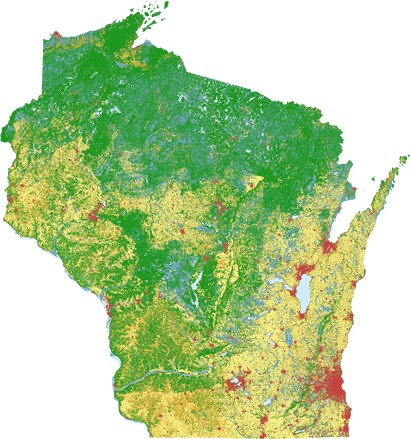
Vegetation and land cover have both been mapped in the past, but newer technologies provide more sophisticated approaches. In cooperation with several federal programs, in particular the National Biological Service's Gap Analysis Program (GAP) and the USDA Natural Resources Conservation Service, the WISCLAND partners have interpreted digital data from the Landsat Thematic Mapper (TM) satellite to produce this layer.
WISCLAND analyzed dual-date images, primarily from 1992, using advanced image processing and GIS techniques based on research by the University of Wisconsin Madison's Environmental Remote Sensing Center. The resulting information layer has a minimum mapping unit of 5 acres, and is usable at scales of 1:40,000 to 1:500,000 for a wide variety of resource management and planning applications. The land cover classification scheme was developed to be compatible with other existing classification schemes such as the UNESCO and the Anderson classification schemes, for example.
This analysis work was done by WISCLAND-funded staff at the Wisconsin Department of Natural Resources which also was the largest state agency contributor to the effort. For details, or to download digital data, visit the Wisconsin DNR web site devoted to this completed layer.
The Wisconsin Land Cover Map became available in late 1999. It depicts the state of Wisconsin according to the type of land cover. The map was derived from a comprehensive digital database created by computerized interpretation of satellite images which was completed in the summer of 1999.
The focus of this component has been the update of the digital Wisconsin Wetlands Inventory (WWI), a foundational element of the Wisconsin Land Information Program. Many updates and corrections have been made to hardcopy WWI maps since the original inventory was completed. Previously, due to funding constraints, these updates had not been incorporated into the digital version of WWI. Also, several counties have been remapped, necessitating redigitization. Thanks to the support of the WISCLAND partners, and significant grants from the US EPA and the Wisconsin Coastal Management Program, this work was completed in mid-1997.
In the early stages of the Rural Land Cover component, WISCLAND partners recognized that finer spatial detail and additional land use categories are needed for landscape-scale work in urban, suburban and exurban areas. This enhanced mapping requires a more intensive approach for small portions of the landscape. While such an approach is desirable statewide, it also would be cost-prohibitive. Thus, a separate component was identified to apply these methods to the areas requiring such treatment. In addition to facilitating land use mapping, this component is directed at supplying technical assistance to land use and transportation planning efforts for developed areas. Potential types of assistance include providing various landscape GIS datasets to local and regional planners, GIS hardware and software, training in land use mapping techniques, and GIS analytical models to support the planning process.
Digital orthophotos contain a tremendous amount of raw information about our landscape. They portray a rich representation of features on the Earth's surface. They can be used as a data source for "heads up" (on-screen) digitizing, as a cartographic backdrop for on-screen or hardcopy GIS-produced maps, or as a source of qualitative information. Production of orthophotos requires completion of digital elevation models, which also are useful for many hydrologic and topographic applications. A number of WISCLAND partners interested in achieving statewide coverage of these datasets are working to accomplish this goal.
Our state is blessed with abundant water resources and many organizations require information about our waters. Several WISCLAND partners are working together under this landscape theme to complete a statewide 1:24,000-scale GIS hydrography layer. An advanced data model has been developed for this component and several pilot projects have been completed. Permanent standard identifiers for all hydrologic features are included in the database design. This will allow attribute information developed as part of the initial project to be integrated with higher resolution, locally-produced representations of our state's waters as these are developed.
The initial phase of this project is completed statewide. For specifics on project status, database design, and other details, visit the DNR GeoServices web site's section on 1:24,000-scale hydrography at: http://www.dnr.state.wi.us/maps/gis/datahydro.html.
A number of 1:24,000-scale Flood Insurance Rate Maps have been prepared by the Federal Emergency Management Agency (FEMA). FEMA plans to digitize these maps over the next few years. The scale of these maps, as well as their accuracy and extent of coverage, are inadequate for local land use planning and zoning.
The Wisconsin Department of Natural Resources (DNR), in cooperation with Winnebago County, has completed a pilot project which used 2-foot contour data from the County and the original floodplain survey profiles to automate the remapping of floodway and floodfringe areas. A significant improvement in accuracy was achieved through this project. It is hoped that additional projects can be sponsored to improve floodplain mapping through local implementation of these techniques using similar, locally produced data.
The Wisconsin Department of Natural Resources has completed a project producing a statewide,1:24,000-scale representation of the Landnet. The Landnet is a generalized cartographic representation of the Public Land Survey System as depicted on USGS topographic maps. It serves as the reference framework for a large number of important landscape datasets that represent years of field observations by natural resource managers and scientists.
Like other WISCLAND landscape themes, a primary aspect of this theme is to involve all potential users in the effort. Of particular importance for Landnet was the development of a data model that will allow inclusion of locally-produced, survey level data. This will improve the quality, accuracy and resolution over time to better meet land records modernization needs.
Automation of existing modern soil survey maps, and statewide completion or update of such maps, are the goals of this landscape theme. Soil survey data are useful for a wide array of applications, and the availability of digital soils maps will multiply their utility. WISCLAND intends to increase the attention paid to this important landscape theme which, along with the WWI and floodplain mapping, are foundational elements of the Wisconsin Land Information Program.
DRGs are digital images that depict the contents of U.S. Geological Survey quadrangle maps. While these scanned images have limited analytical potential, they are quite useful as background images upon which vector GIS-based layers can be presented. DRGs can also be draped over DEMs. Through fundraising efforts under the WISCLAND umbrella, these image maps were produced in cooperation with the US Geological Survey. WISCLAND enhanced theses files to simplify their state-wide seamless use in Arc View GIS software. These products became available statewide in mid-1997.
Development of GIS databases that represent additional themes of the state's landscape can be coordinated under WISCLAND. All that is necessary is for partners to define the project, agree on a process, and assemble the resources. The existing WISCLAND institutional linkages can be used to foster the necessary cooperative spirit.
The WISCLAND concept represents a new way of doing business. The initiative serves as a virtual umbrella organization to promote the development, analysis and use of landscape GIS data elements. It facilitates the creation of a "common market" within which GIS data users and producers can work cooperatively to better accomplish their mutual objectives. This "brokerage" function has already achieved significant results, and it is just getting started! As of September, 1998, the following entities have joined the WISCLAND partnership or made significant contributions toward accomplishing its objectives:
Wisconsin State Agency Partners
Department of Natural Resources
Department of Transportation
Department of Agriculture, Trade and Consumer Protection
Department of Revenue
Department of Health and Social Services
Department of Administration
Wisconsin Geologic and Natural History Survey
Board of Commissioners of Public Lands
Federal Agency Partners
USDA - Natural Resources Conservation Service
USDOI - USGS, Biological Resources Division, Gap Analysis Program
USEPA - Great Lakes National Program Office
USDA - Forest Service, Chequamegon and Nicolet National Forests
USDOI - USGS, Water Resources Division
USDOI - National Park Service
Local and Regional Partners
St. Croix, Oconto and Marinette Counties
East Central Wisconsin Regional Planning Commission
West Central Wisconsin Regional Planning Commission
North Central Wisconsin Regional Planning Commission
Other Partners
Alliant (formerly Wisconsin Power and Light)
Wisconsin State Cartographer's Office
Wisconsin Land Information Board
UW-Madison - Institute for Environmental Studies
UW-Madison - Environmental Remote Sensing Center
UW-Madison - Land Information and Computer Graphics Facility
Organizations become official cooperators in WISCLAND by signing The Articles of Participation. The Articles are comprised of a short document describing the purpose and structure of WISCLAND, to which are attached a series of documents that describe the more specific major roles and responsibilities of each organization, particularly focused on individual thematic data layers.
There are two primary levels of activity in WISCLAND. First a steering committee sets direction and maintains oversight. This group typically meets every 3 months for 3 hours. (see scheduled events) All signatory organizations have a seat on this committee, although virtually all decisions are by consensus.
In order to formulate, initiate, and maintain project work surrounding specific data layers, WISCLAND forms thematic working groups that then report to the steering committee.
WISCLAND has no budget or staff, but individual projects are supported by people and other resources housed in cooperating organizations. To make progress in this way, WISCLAND organizations shift resources to where the work is being done.
WISCLAND shares many goals and approaches with the Wisconsin Land Information Program (WLIP). Both are voluntary, both seek to develop integrated approaches to modernization, and both promote the sharing of resources and resulting products. These two activities are highly complementary, with the WLIP focused on local land information and WISCLAND focused on landscape information that extends over multiple counties and the entire state. The relationships between WLIP Foundational Elements and WISCLAND landscape themes are illustrated by a detail table.
All entities interested in working together to advance the state of GIS, LIS or Land Records Modernization are cordially invited to join the partnership. Interested parties should contact Bob Gurda, Assistant State Cartographer and Chairman of the WISCLAND Steering Committee, to find out how they can participate in the activities of one or more of the landscape theme working groups.
Contact:
Bob Gurda
State Cartographer's Office
550 North Park Street
Madison, WI 53706
Phone: (608) 262-6850
Fax: (608) 262-5205
Email: rfgurda@facstaff.wisc.edu
Return to TopThe Steering Committee will meet on December 13 at the USGS-WRD District Office in Middleton. The meeting will run from 12 noon - 3:00 pm.
Anyone is welcome to attend.
In the event of a major winter weather event on the 13th, call the State Cartographer's Office (608/262-6850) to check on possible cancellation of the meeting.