
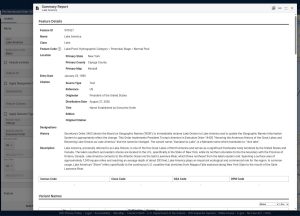
Cartographers in New York state have some work to do. Pursuant to Interior Secretary Burgum’s Order 3453, Lake Ontario is now officially known as Lake America … at least in the United States.
This is the third order from the Trump administration changing the names of geographic features. Last year, the administration renamed the Gulf of Mexico to the Gulf of America, and Denali (a mountain in Alaska) to Mt. McKinley. For more details on these changes see Renaming Denali and the Gulf of Mexico and Mt. McKinley Gets a Redo
The Trump administration is not alone in issuing orders to rename geographic features, although the motivations vary case to case. For example, Trump’s Mt. McKinley renaming reversed a 2014 order by the Obama administration, which renamed Mt. McKinley to Denali. And in 2012, Interior Secretary Deb Haaland issued an order to change hundreds of “Sq—-” names across the country.
Burgum’s Order states,
This Order directs the Board on Geographic Names (BGN) to immediately rename the body of water known as Lake Ontario to Lake America and to update the Geographic Names Information System to appropriately reflect the change. This Order implements President Trump’s direction in Executive Order (EO) 14420, titled “Honoring the American History of the Great Lakes and Renaming Lake Ontario as Lake America,” that the name be changed.
The rationale for the change is given as follows,
The area formerly known as Lake Ontario has long been an integral asset to America, as a critical artery for America’s early trade and commerce, and as a vital economic resource for America. Lake America will continue to play a pivotal role in shaping America’s future and the global economy.
There seems to be a typo in this order, since Executive Order 14420 is titled “Declaring a National Emergency to Secure the United States Bulk-Power System.” The Lake America order has no assigned Executive Order number, but is titled “Honoring the American History of the Great Lakes and Renaming Lake Ontario as Lake America.”
The order acknowledges Canada’s shared interest in the lake, but notes that with “the deepest parts of the Lake’s waters lying within United States territory, the United States claims most of the Lake’s volume.” The Order states that the goal of the name change is to “recognize the extraordinary contributions of the American people and the rich heritage of our history by naming great natural landmarks for our shared achievements.”
The change has been made to the Geographic Names Information System (GNIS), the repository of official US names. See the screenshot at the heading of this post. Official maps – including basemaps used by federal agencies online, US Geological Survey topographic maps, and maps and charts issued by other agencies – will adopt the new name, but this will take time due to the complex workflows often used to create these maps.
In GNIS, Lake Ontario is now listed as a variant name, along with a long list of other variant names, including: Cadaraqui, recorded by one James Hadeen Smith in 1881; Kaniatarí:io Lake, a Mohawk name that translates to the English “nice lake”; Lac Ontario, a French spelling; Lac des Iroquois; Lago Ontario; Lake of Saint Louys; Saint Louis Lake; Lake of the Entouhonorons; Nyah-gaah; O-hu-de-a-ra; Ohudeara; Oswego; and Skanadario.
Federal agencies are required to comply with Presidential and Secretarial Orders on official name changes. However, since Lake Ontario/Lake America is not wholly within the United States, it will no doubt continue to be called Lake Ontario by people outside of the United States. (The same is true for the Gulf of Mexico/Gulf of America).
As with the changes for Denali and the Gulf of Mexico, many articles and opinions have been published on how map companies like Google and Apple are responding. It should be noted that mapping companies generally try to comply with official name changes, since otherwise their maps would be a mixture of official, conventional, local and unofficial names. This is how Google explained their adoption of Lake America.
Like other companies, Google localizes its place names based on the location of the user. So, users in Canada will continue to see Lake Ontario. That practice has a long history going back to the days of paper maps and atlases, when mapping companies would produce different products for different countries. Some companies also provide the former name in parentheses as an alternate name on maps and in gazetteers.
Mapping companies are in a bit of a bind in these situations and their compliance with the new name should necessarily be read as a sign that they endorse the change.
Thankfully, for us in Wisconsin, the current administration’s name changes have not affected our part of the country. There’s a lot of work involved in such changes. There are maps to republish, websites to update and official signs to change, not to mention the thousands of references in tourist brochures and textbooks, should publishers choose to make them.
Meanwhile, we’ll have to see how people react to the change. Will the new name become the norm or will most people continue to call it Lake Ontario? The state of New York may continue to use Lake Ontario on its maps and publications, rather than adopting the new federal name. As New York Governor Kathy Hochul’s said in reaction to the news, “New York won’t be calling it that.”